News & Event
- Home
- News
- News & Event
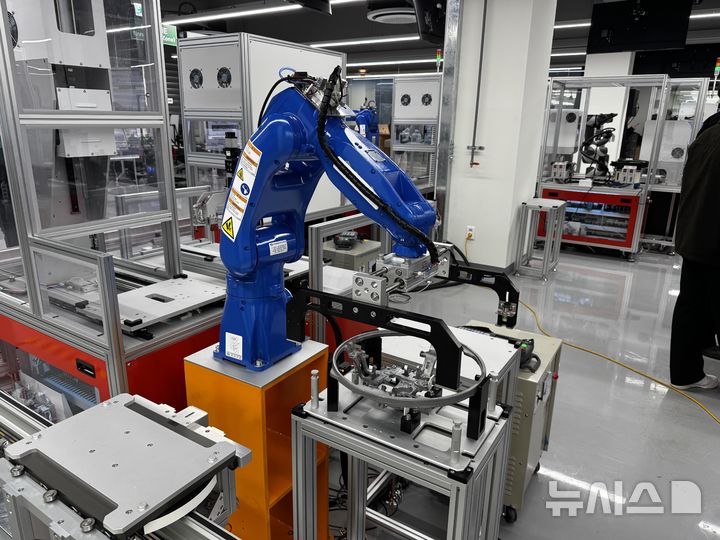
[Seoul=Newsis] Reporter Shim Ji-hye – An automated robot installed at the Jeonbuk Physical AI Demonstration Lab located within Chonbuk National University. 2026.01.26.
According to Newsis,
[Seoul = Newsis] Reporter Shim Ji-hye – DH Autolead, a steering wheel manufacturer in the Jeonbuk region, has achieved an 80 percent reduction in manufacturing costs by implementing robot automation based on Physical Artificial Intelligence (AI). Daeseung Precision, which automated its cutting processes, reduced its defect rate by 19.4 percent, while Donghae Metals, which introduced Physical AI into its body part welding and assembly processes, shortened production lead times by 10 percent.
These results were achieved through the "Physical AI Pre-verification Project" promoted by the Ministry of Science and ICT (MSIT) last year, which was practically applied to manufacturing sites in the Jeonbuk region. As significant improvements were confirmed in key indicators such as productivity, quality, and process efficiency, it is uated that the potential for linking Physical AI-based manufacturing innovation with regional projects has been demonstrated.
The MSIT announced on the 26th that it held a performance-sharing meeting for the "Physical AI Pre-verification Project" at Chonbuk National University.
[Establishing Demonstration Labs in Jeonbuk and KAIST... Verifying Applicability in Manufacturing and Logistics]
The MSIT and the National IT Industry Promotion Agency carried out the Physical AI Pre-verification Project based on last year’s supplementary budget. Led by Chonbuk National University, participants included KAIST, Sungkyunkwan University, CAMTIC, and demonstrating companies such as DH Autolead, Donghae Metals, and Daeseung Precision. A total of KRW 22.9 billion in national funds was invested over five months from August to December last year.
The project involved establishing demonstration labs at Chonbuk National University (Manufacturing) and KAIST (Logistics) to verify on-site applicability based on processes, equipment, and data. It was conducted by applying Physical AI-based Autonomous Mobile Robot (AMR) logistics automation, machine tending automation, and flexible production systems for multi-product manufacturing to the processes of three demand companies in the automotive sector.
The Chonbuk National University Demonstration Lab is the first platform to establish a basis for on-site Physical AI demonstration, built to enable technology verification by function, such as assembly, inspection, labeling, and flexible production. It is divided into a Production Zone (P-Zone) and an Innovation Zone (I-Zone) to allow simultaneous verification of "experiment and production" scenarios.
It will serve as a platform to verify the collaborative operation of heterogeneous systems while allowing real-time verification of various production scenarios and technologies. The companies that participated in the pre-verification project explained that they confirmed significant improvements in key indicators such as productivity, quality, and process efficiency after applying Physical AI technology to their major processes.
Based on the demonstration results accumulated through this project, the MSIT plans to promote the "Physical AI Jeonbuk Regional AI Transformation (AX) Project (R&D)" in the first half of this year. The core content of the project is the development of a Physical AI-based heterogeneous robot collaborative intelligence software (SW) platform solution by 2030. The scale of the project will be finalized after the feasibility review.
[Demonstrating Companies: Reducing Costs and Improving Defect Rates]
During the performance-sharing meeting, Vice Minister of Science and ICT Bae Kyung-hoon toured the Chonbuk National University Demonstration Lab and reviewed the application cases and results of each company.
Vice Minister Bae listened to explanations from officials of DH Autolead, Daeseung Precision, and Donghae Metals regarding the results of applying Physical AI technology and the on-site implementation process. They discussed ways to link and expand the achievements confirmed during the pre-verification stage to future regional AX projects.
Specifically, DH Autolead increased production by 7.4 percent and shortened production lead times by 7.4 percent by applying AMR-based unmanned transport and digital twin-based automated robot post-processing. Notably, by automating previously manual-intensive processes, manufacturing costs were reduced by up to 80 percent.
Daeseung Precision increased production by 11.4 percent and reduced defect rates by 19.4 percent by applying a machine-tending system where robots perform the loading and unloading of cutting equipment. In the process, they also achieved a 75 percent reduction in manufacturing costs.
Donghae Metals promoted a process transition to respond to high-mix, low-volume production by applying a Physical AI-based flexible production and integrated control system to its body part welding and assembly processes. As a result, production increased by 5.1percent, lead times were shortened by 10 percent, and manufacturing costs were reduced by 14.3 percent.
During the subsequent on-site meeting, company representatives and experts, including CEO Lee Seok-geun of DH Autolead, CEO Kim Jang-song of Daeseung Precision, CEO Seo Ho-jin of Donghae Metals, Professor Kim Soon-tae of Chonbuk National University, and Professor Jang Young-jae of KAIST, discussed implementation tasks for internalizing Physical AI manufacturing innovation in Korea.
Attendees agreed that for Physical AI technology to become a sustainable competitive advantage in industrial sites, demonstration-oriented policy support and institutional backing are necessary.
The MSIT plans to reflect the opinions raised during the meeting in the design of future regional AX projects and the preparation of policy support measures.
Vice Minister Bae Kyung-hoon emphasized, "The Chonbuk National University Physical AI Demonstration Lab is the starting point and a hub for the spread of Physical AI manufacturing innovation. Since Korea already possesses world-class manufacturing sites and an industrial foundation optimized for Physical AI—such as semiconductors, mobility, and robotics—we must verify these on-site to secure independent technologies and industrial competitiveness."
He added, "We will strengthen government support and policy linkage so that technologies verified through on-site demonstrations can lead to actual process application and spread widely across industries. Moving forward, we will fully activate Physical AI manufacturing innovation by linking regional AX with the '5 Poles and 3 Special Zones' strategy."
◎ NEWSIS, siming@newsis.com
Copyrights Newsis. All Rights Reserved. Reprint or redistribution without permission is prohibited.
Source Text
Source: Newsis (January 26, 2026)
** This article was translated from Korean.