News & Event
- Home
- News
- News & Event
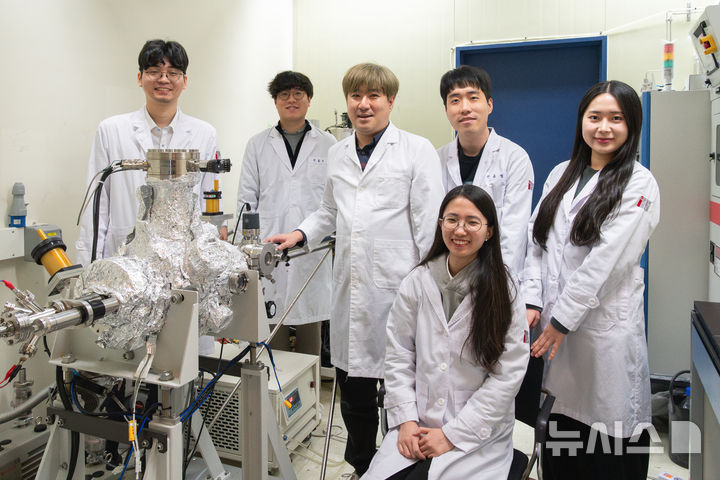
[Gwangju = Newsis] (From left) GIST Department of Chemistry’s Kim Do-hoon, Ahn Chae-hyun, Professor Lim Hyun-seob, Jeon Jun-byeong, Joo Hye-ri, and (seated) Oh Ju-hee. (Photo = Provided by GIST) photo@newsis.com
According to Newsis,
[Gwangju = Newsis] Reporter Lee Chang-woo – The Gwangju Institute of Science and Technology (GIST) announced that a research team led by Professor Hyun-seob Lim of the Department of Chemistry has developed a non-destructive analysis technology that can accurately determine whether next-generation semiconductor materials have been properly synthesized without damaging the samples.
As silicon, the current mainstay of the semiconductor industry, faces limitations in maintaining performance and power efficiency as miniaturization progresses, "two-dimensional (2D) semiconductors," which are only one atom thick, are gaining attention as a next-generation material to replace it.
Among these, Molybdenum Disulfide (MoS₂) is a representative candidate material.
However, to apply 2D semiconductors to actual chips, the atoms must maintain a "single-crystal" state, where they are perfectly aligned in one direction. Even if they appear perfect on the surface, in many cases, domains flipped 180 degree are mixed in, which significantly degrades device performance.
The problem was that most existing analysis methods to verify single-crystal status involved cutting or damaging the samples, making them difficult to apply to semiconductor wafer processes.
To solve these limitations, Professor Hyun-seob Lim’s research team utilized Low-Energy Electron Diffraction (LEED) techniques. By precisely analyzing the changes in diffraction signal intensity that occur while varying the electron beam energy, they succeeded in clearly distinguishing between "true single crystals" and crystals with mixed orientations without damaging the sample at all.
A key feature of this technology is that it goes beyond simply viewing images and presents a new interpretation standard for quantitatively judging the degree of crystal alignment.
The researchers expect that this technology, which allows for checking the crystal quality of an entire wafer at a glance—much like an X-ray—will be able to dramatically increase yields in the mass production process of 2D semiconductors.
Furthermore, this method can be applied not only to MoS₂ but also to various other 2D semiconductors and ultra-thin stacked structures, suggesting a high possibility of expanding into a standard quality control technology for the overall next-generation semiconductor process.
Professor Hyun-seob Lim stated, "In order for next-generation semiconductor materials that surpass silicon to be applied in actual industrial fields, large-area synthesis technology and reliable uation technology to verify it must be established together. This developed non-destructive analysis method will serve as an important bridge connecting 2D semiconductor research, which had remained at the laboratory level, to wafer processes in the industrial field."
This research was conducted with support from the Ministry of Science and ICT and the National Research Foundation of Korea. The research results were published online on January 8, 2026, in the international academic journal 'Nano Letters.'
◎ NEWSIS, lcw@newsis.com
Copyrights Newsis. All Rights Reserved. Reprint or redistribution without permission is prohibited.
Source Text
Source: Newsis (January 22, 2026)
** This article was translated from Korean.