News & Event
- Home
- News
- News & Event
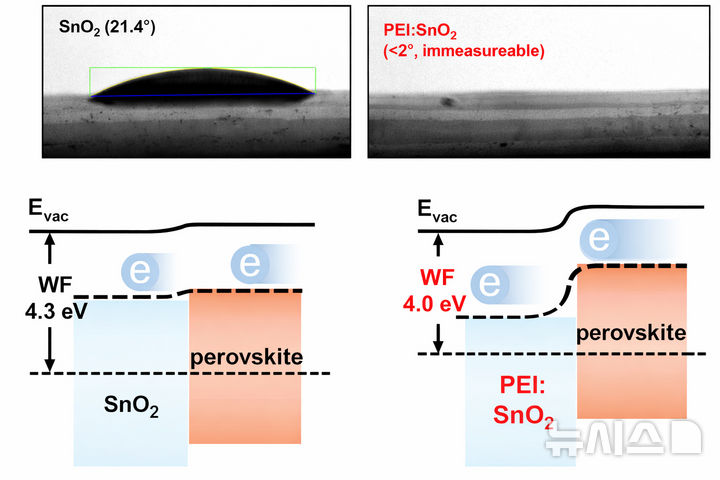
(Image Caption) Diagram comparing wettability and electron transport phenomena at the interface of unmodified SnO₂ versus modified SnO₂. (Graphic provided by GIST)
According to Newsis,
(Gwangju=Newsis) Lee Chang-woo = Korean researchers have developed a core technology that prevents drops in efficiency and stability even when manufacturing large-area perovskite solar cells.
The Gwangju Institute of Science and Technology (GIST) announced that a research team led by Deputy Director Kang Hong-kyu of the Research Institute for Solar and Sustainable Energies, in collaboration with researchers from Kangwon National University, has developed a process to precisely control the interface between internal layers of solar cells. This breakthrough solves the issue of performance degradation in large-area cells, which has been considered the biggest hurdle to commercialization.
The research team implemented a technology that simultaneously reduces surface defects and electron loss by mixing the polymer 'PEI' during the initial formation stage of the electron transport layer (SnO₂), which is responsible for electron movement within the solar cell.
This process is a simple method that can be applied without the need for additional equipment or complex procedures.
The solar cell module applying this technology recorded a power conversion efficiency of 22.56 percent even on a large area of 24.8㎠, approximately one-quarter the size of A4 paper.
Furthermore, it demonstrated high stability by maintaining approximately 94 percent of its initial performance even after over 500 hours of use.
Perovskite solar cells are garnering attention as next-generation solar cells due to their light weight and simple manufacturing process.
However, a significant challenge existed where performance and lifespan dropped sharply as the surface area increased, due to the difficulty of forming even thin films.
By directly controlling the electron transport layer interface, the research team simultaneously improved thin-film uniformity and electron transport characteristics, confirming that stable power generation is possible without performance degradation even in large areas.
Deputy Director Kang Hong-kyu stated, "This research is significant as it simultaneously solved the issues of wettability and thin-film uniformity—key challenges for large-area perovskite solar cells—through a simple process." He added, "Having secured both high energy conversion efficiency and long-term stability, we expect this to contribute to accelerating the commercialization of perovskite-based large-area solar cells."
This research was conducted with support from the Ministry of Education, the National Research Foundation of Korea, the Ministry of Trade, Industry and Resource, Gangwon State, and GIST. The research results were published online in the international academic journal Small on December 19.
For inquiries regarding technology transfer, please contact the GIST Technology Commercialization Center.
◎ NEWSIS, lcw@newsis.com
Copyrights Newsis. All Rights Reserved. Reprint or redistribution without permission is prohibited.
Source Text
Source: Newsis (January 27, 2026)
** This article was translated from Korean.